Hippolytus
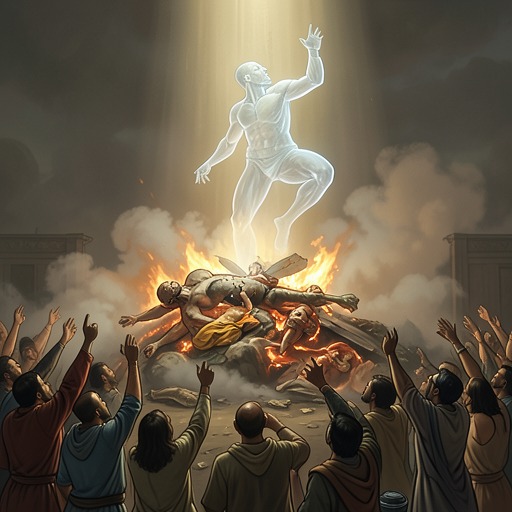
Metamorphoses (Ovid Edition)Hippolytus is defined by a double passage through death. The remembered account presents him as a young man betrayed by Theseus’ easy faith and sent to his death, while the later narrative preserves him as a survivor of the underworld who returns under another name. His decisive significance lies in the tension between irreversible loss and metamorphic renewal: Hippolytus does not simply escape death, but crosses it and emerges with a changed face and identity.
Identity and Tragic Background
Hippolytus first appears within a recollection offered as consolation to a grieving nymph. His story is introduced as an old example of suffering, and its central injustice is immediately identified: Theseus’ trust is described as easy, meaning that Hippolytus’ death follows from a judgment accepted too readily rather than from a fully established truth. The young man therefore occupies the tragic position of the falsely condemned, destroyed by another person’s credulity.
The account does not present his death as the end of his existence. Instead, it makes the underworld the first stage of a larger transformation. Hippolytus says that he saw the dark realms of woe and bathed his wounds in smoking streams below; he might have remained there and enjoyed no second life, but a divine intervention changes that outcome. His experience joins bodily injury, descent, and restoration into one continuous pattern.
Death, Descent, and Restoration
Hippolytus’ passage into the realm of the dead is marked by wounds and by the oppressive imagery of smoking waters. The scene gives physical form to the consequences of Theseus’ mistake: the wronged man carries the damage of judgment into death itself. Yet the narrative refuses to treat the underworld as a final boundary. Hippolytus’ statement that he could have remained there without a second life makes restoration appear exceptional, not automatic.
The transformation is registered in his body. His former hue has changed, and in its place appear a set of features and a face unknown. This is more than healing. The returner cannot simply resume the exact identity that entered the underworld, because the body itself now bears the evidence of passage through death. Restoration consequently depends upon alteration: life is recovered through a visible break with the former self.
From Hippolytus to Virbius
After his return, the restored figure is associated with a new name, Virbius. The change of name corresponds to the changed face and confirms that the second life is not merely a continuation of the first. Hippolytus survives, but survival requires a reclassification of who he is. The narrative thus makes identity relational and transformable: the condemned youth, the wounded inhabitant of the underworld, and the renewed figure called Virbius belong to one life, yet they are not identical forms of it.
A goddess stands in doubt over the place of his retreat, considering Crete or Delos before choosing the wood where he will remain. The rejected alternatives and the final woodland refuge give his renewed existence a carefully selected setting. Hippolytus’ second life is therefore not a return to the social world that condemned him. It is a removal into another space, where his transformed identity can persist beyond the circumstances of Theseus’ error.
Narrative and Thematic Significance
Hippolytus’ story functions as a story of consolation because it places private grief within a wider succession of metamorphoses. The surrounding work repeatedly moves between human bodies and altered forms, and Hippolytus offers an especially complex version of that movement: death does not erase him, but neither does resurrection restore him unchanged. His new existence is secured by bodily difference, a new name, and a new dwelling.
The episode also sharpens the moral force of mistaken judgment. Theseus’ easy faith produces a death that the gods must overcome, so the later restoration does not cancel the original injustice. Instead, it preserves the cost of believing too quickly while allowing the victim a second mode of being. Hippolytus’ arc therefore combines tragic reversal with metamorphic renewal: a life broken by another’s error is returned only after it has passed through suffering, estrangement, and change.